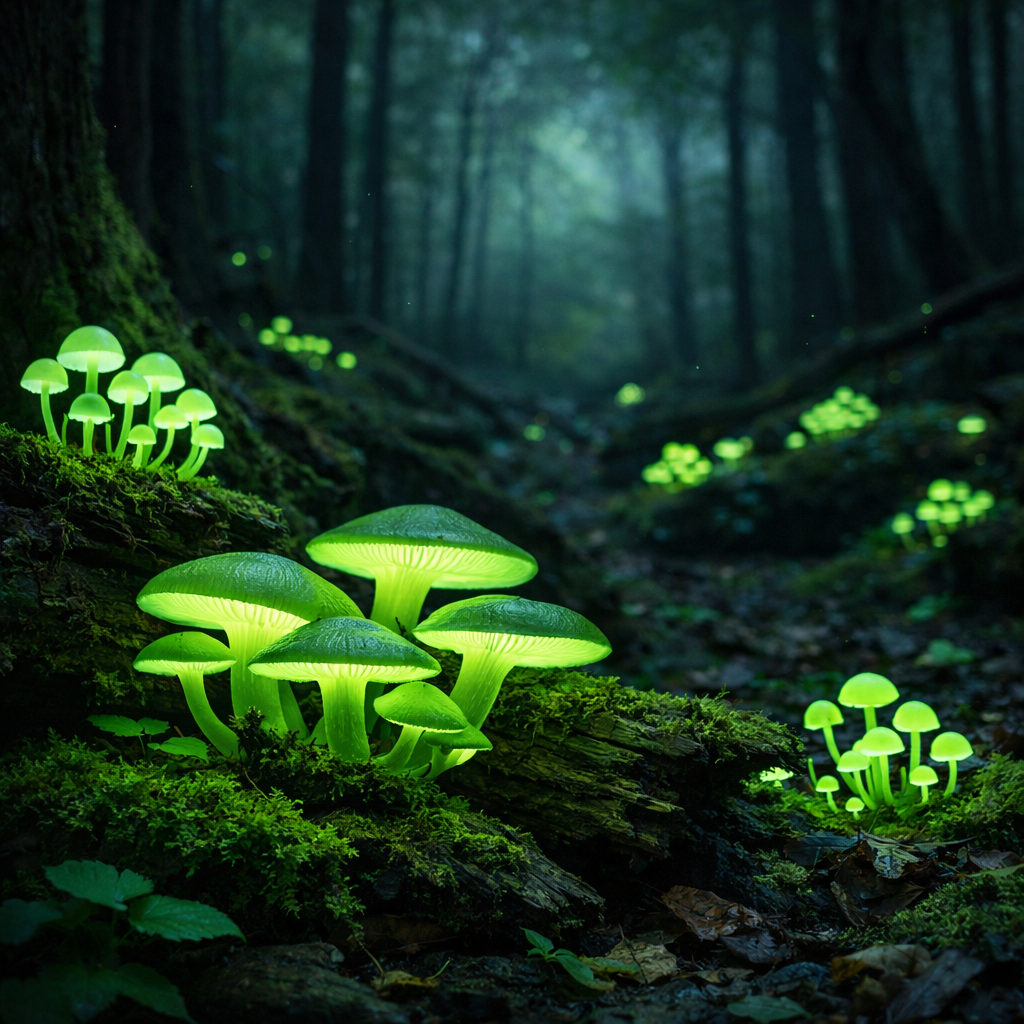
Imagine walking through a quiet forest at night. Everything is dark and silent. Suddenly, you notice a faint green glow on the forest floor. At first, it might feel like your eyes are playing tricks on you. But as you move closer, you realize the light is real.
That mysterious glow is coming from bioluminescent mushrooms.
These rare mushrooms that glow in the dark produce natural light through a fascinating biological process. Hidden among leaves and decaying wood, these glowing fungi turn an ordinary forest into something magical.
For more than a century, scientists have been fascinated by bioluminescent fungi and the strange chemistry behind their glow. At MushroomGroov, we love exploring the mysterious world of mushrooms and sharing what makes them so unique. In this article, we’ll explore how glowing mushrooms work, where they grow, and why they are important for forest ecosystems.
What Are Bioluminescent Mushrooms?
Bioluminescent mushrooms are a special type of fungi that can produce their own light. This glow usually appears as a soft green or yellow-green color and is easiest to see in complete darkness.
Scientists have identified around 80 species of bioluminescent fungi across the world. Some well-known glowing mushroom species include:
- Mycena chlorophos
- Panellus stipticus
- Omphalotus olearius (also called the Jack-O’-Lantern mushroom)
- Neonothopanus gardneri
These glowing mushrooms may look beautiful, but many of them are toxic. They should only be observed in their natural habitats and never eaten unless identified by experts.
Why Do Mushrooms Glow in the Dark?
The glow from bioluminescent mushrooms comes from a chemical reaction inside their cells.
This process involves a compound called luciferin. When luciferin reacts with oxygen, an enzyme called luciferase helps trigger the reaction. As energy is released, light is produced.
This natural light-producing process is similar to the way fireflies glow at night.
Scientists believe the glow serves an important purpose. The light may attract insects during the night. When insects land on the mushroom, they can carry fungal spores to new places in the forest. This helps the fungi spread and reproduce.
So the glow of these mushrooms that glow in the dark may actually be a clever survival strategy.
Where Do Bioluminescent Mushrooms Grow?
Bioluminescent fungi can be found in many parts of the world, but they grow best in warm and humid environments. Forests rich in decomposing wood and leaf litter provide the perfect habitat.
Some regions where glowing mushrooms are commonly found include:
- Brazil
- Southeast Asia
- Japan
- Australia
- North America
Most bioluminescent mushrooms grow on rotting logs or decaying wood. These fungi feed on organic material and help break it down.
While a fallen log may appear lifeless, it actually supports an entire ecosystem of organisms. Fungi play a crucial role in recycling nutrients back into the soil.
Without fungi like these, forests would quickly fill up with dead plant material.
Why Bioluminescent Mushrooms Are Important for Ecosystems
Although glowing mushrooms look mysterious and magical, their role in nature is very practical.
Like other fungi, bioluminescent mushrooms act as natural decomposers. They break down dead plants, fallen trees, and organic debris on the forest floor.
During this process, nutrients are released back into the soil. Plants can then absorb these nutrients and continue growing.
In this way, fungi act as nature’s recycling system.
Without mushrooms and other fungi, forest ecosystems would struggle to maintain balance. Dead plant material would pile up, and nutrients would stop cycling through the environment.
So while bioluminescent fungi may look like tiny forest lanterns, they are also essential workers in maintaining healthy ecosystems.
Fascinating Facts About Glowing Mushrooms
These mysterious mushrooms that glow in the dark have several surprising features:
- Their glow is strongest in complete darkness.
- Some species glow continuously throughout their life cycle.
- Others glow more brightly when producing spores.
- The glowing phenomenon is sometimes called “foxfire” or “fairy fire.”
- Scientists are studying bioluminescent fungi for possible uses in biotechnology.
- Researchers are exploring whether these glowing systems could inspire natural lighting or biological sensors in the future.
Although these ideas are still experimental, the natural chemistry behind glowing mushrooms continues to inspire scientific curiosity.
Discover the Hidden World of Glowing Mushrooms
Bioluminescent mushrooms remind us that nature is full of hidden wonders. Deep within forests, these glowing fungi quietly light up the night while playing an essential role in the ecosystem.
At MushroomGroov, we are passionate about exploring the fascinating world of fungi — from rare forest species to the science behind bioluminescent mushrooms.
Whether you’re new to mushrooms or already fascinated by fungi, there is always more to discover.
So the next time you walk through a forest at night, look closely. You might just spot the faint glow of mushrooms that glow in the dark, quietly lighting the forest floor.